15th April 2026, 6:30 PM IST
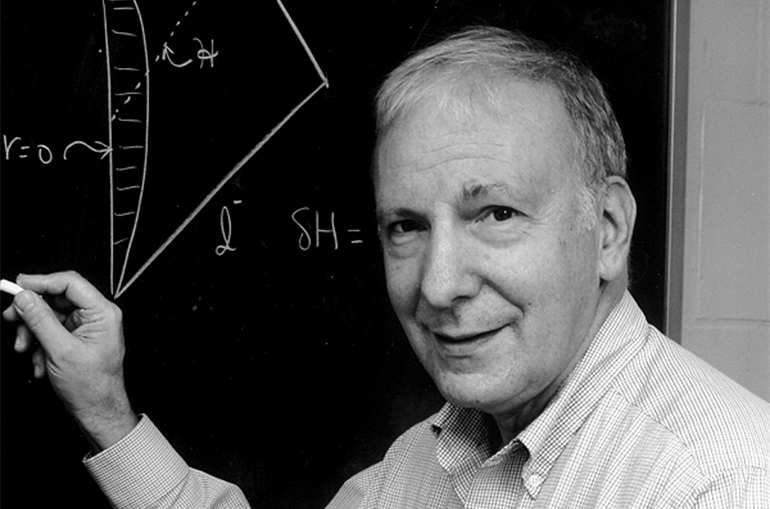
Robert M. Wald (born June 29, 1947 in New York City) is an American theoretical physicist and professor at the University of Chicago. He studies general relativity, black holes, and quantum gravity and has written textbooks on these subjects. In 1977, Wald published a popular-science book titled Space, Time, and Gravity: The Theory of the Big Bang and Black Holes explaining Albert Einstein's general theory of relativity, and its implications in cosmology and astrophysics.
In the past few years, one of my main research efforts has concerned the formulation of quantum field theory in the presence of gravity, i.e., quantum field theory in curved spacetime. In this approach, gravity is treated classically, but all other fields are treated in accord with the principles of quantum field theory. Some major issues of principle arise in the formulation of this theory on account of the lack of Poincare symmetry and the absence of a preferred vacuum state, but it has recently been shown that the theory can be formulated in a fully satisfactory manner. It is my hope that this will provide important clues to the formulation of a fully quantum theory of gravity itself.
We show that if a massive body is put in a quantum superposition of spatially separated states, the mere presence of a black hole in the vicinity of the body will eventually destroy the coherence of the superposition. This occurs because, in effect, the gravitational field of the body radiates soft gravitons into the black hole, allowing the black hole to harvest "which path'' information about the superposition. A similar effect occurs for quantum superpositions of electrically charged bodies. The effect is very closely related to the memory effect and infrared divergences at null infinity.